Handwriting foundations · Ages 3–12 · Kuala Lumpur & online
Get the first stroke right, and everything after it gets easier.
Correct pencil grip and letter formation for children aged 3–12 — taught through movement and play by Teacher Jameela, who has been guiding young writers since 1977. Fix the foundation, and reading, maths and confidence follow on their own.
On WhatsApp, in English or Bahasa Malaysia. No obligation — just an honest read of your child's writing.
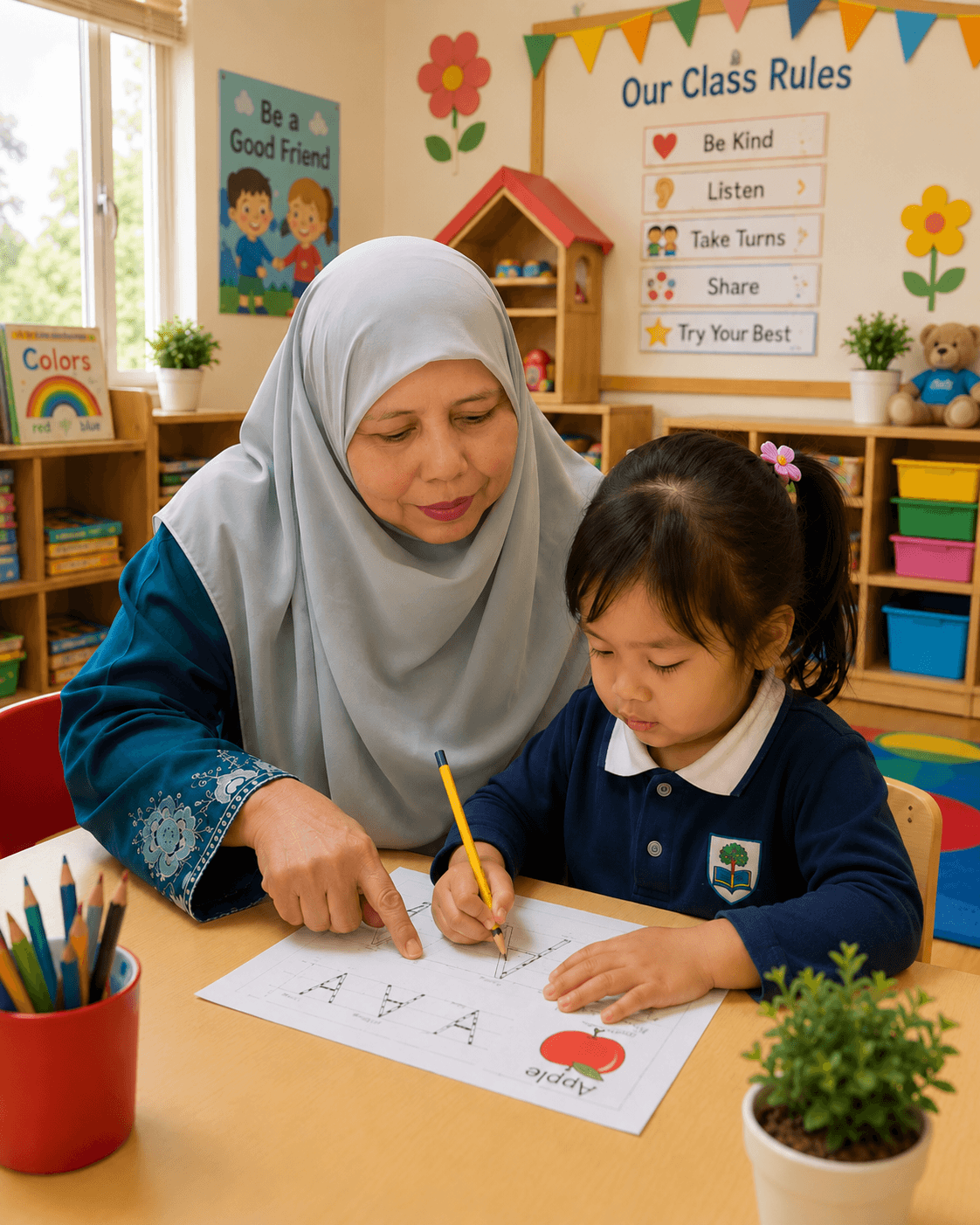
Every letter and number has a starting point and a direction. We teach both — from stroke one.
The signs parents are told to ignore
Seven small signs that a big problem is starting
“It’s just messy writing.” “It’s a phase.” After nearly five decades in the classroom, Teacher Jameela will tell you plainly: these seven signs are the foundation asking for help.
b and d keep swapping
Yesterday it was right; today it is mirrored again.
What it means: the letter was never anchored to a starting point and a direction — so the hand guesses every time.
a looks like u — or c and l
Letters drift apart or collapse into each other.
What it means: letters are being drawn as pictures, not written as strokes. Pictures wobble; strokes hold.
They can’t read their own writing
Even your child squints at last week’s work.
What it means: if they can’t read it back, they can’t check it, revise from it, or learn from it.
Copying from the board is slow
The class has moved on; your child is still on line two.
What it means: each letter is being re-invented instead of written automatically. Focus runs out before the sentence does.
Tired or fidgety after ten minutes
Writing time turns into complaint time.
What it means: a wrong grip makes the hand ache. Children never say “my grip is wrong” — they say “I hate writing.”
Homework is a rushed scribble
Done in five minutes, full of mistakes, just to escape it.
What it means: writing hurts or embarrasses them — so the goal becomes finishing, not learning.
5 looks like S · x looks like ×
Numbers and symbols blur into letters.
What it means: number formation was never taught properly — and this is exactly what makes algebra feel impossible at 13.
Ticked three or more?
It isn’t laziness. And more of the same tuition won’t reach it — because tuition drills content on top of a cracked foundation.
What is at stake
Left alone, a small habit becomes a label
Handwriting problems don’t stay handwriting problems. Teacher Jameela has watched the same quiet cascade repeat for nearly fifty years:
Age 6
“It’s cute — she’ll grow out of it.”
Reversed letters and an awkward grip are waved away as a phase. The habit hardens while the hand is still soft.
Age 8
The first labels arrive
Marked down for untidy work. Called slow, careless, last in class. One boy scored 2 marks in maths — and was told “most of the class did too.”
Age 10
The child believes the label
Reading lags, copying lags, interest fades. “I can’t study” stops being a feeling and becomes an identity.
Age 13
“I hate maths”
Algebra arrives — and a 5 that looks like S, a b that looks like 6, an x that looks like ×, make maths feel impossible. It was never about maths.
No child should be labelled a slow learner because of one small skill that nobody taught them properly. That belief is the reason this academy exists.
The root cause
Why more tuition doesn’t fix it
Most parents respond to falling marks the natural way — another tuition centre, more worksheets, more drilling. But tuition teaches content. It assumes the child can already get thoughts onto paper quickly, legibly, and without pain.
When the grip is wrong and the letterforms were never anchored, that assumption is false. The child spends their concentration on forming letters instead of thinking — in Bahasa Melayu, English, Science and Maths all at once. The root problem is never identified, so it is never rectified.
Teacher Jameela works underneath the tuition — at the root. Her method rebuilds the writing foundation in the order a child’s body actually learns it:
The Move–Grip–Write Method
Whole-body movement first. Then the correct grip. Then the exact path of every letter and number — where it starts, and which way it moves.
Developed across ~2,000 children and 10,000 trained teachers and adults, in English and Bahasa Malaysia.
Move
Whole-body exercises, games and actions build gross and fine motor control — and the left–right brain coordination that writing quietly depends on. Class feels like play; the body is being prepared to write.
Grip
The correct pencil grip, taught gently and checked every single class — so the hand stops aching, speed becomes possible, and “I hate writing” never takes root.
Write
Every letter and number learned from its true starting point and direction — with correct size, spacing and punctuation — until neat, fast writing becomes automatic and reading their own work becomes easy.
What your child gains
Fix one foundation. Watch three things change.
Writes clearly, comfortably, fast
Correct grip ends the aching hand; automatic letterforms end the rushed scribble. Copying from the board keeps pace with the class — in every subject at once.
Reads with confidence
It starts with reading their own writing back — then flows into reading and understanding any text. Comprehension stops leaking marks across Bahasa Melayu, English and Maths.
Learns on their own
The real prize. When writing stops being a battle, homework stops being an escape mission — and your child becomes a self-regulated, progressive learner who wants to improve.
Your guide
Meet Teacher Jameela
As a child, Jameela wrote her own letters in mirror image. She knows exactly how it feels to stare at a page that refuses to behave — and exactly what it takes to overcome it, because she did.
She began teaching preschoolers in 1977. Since then she has taught roughly 2,000 young children, lectured Language and Literacy to preschool teachers since 2000, trained more than 10,000 of them, run her own preschool centre, and raised six children of her own — who went on to become doctors, degree and masters holders.
She also spent a decade lecturing working adults in administration, secretarial practice and management — which is why a class that looks like play is, underneath, remarkably systematic.
Every class she runs — whether a six-week group, a one-to-one rescue session, or a teacher-training day — carries the same method: movement first, grip second, letters third, never rushed and never skipped.
At a glance
- Master of Education — Deakin University, Australia
- Teaching children aged 3+ continuously since 1977
- ~2,000 children taught, one grip and one letter at a time
- Lecturer in Language & Literacy for preschool teachers since 2000
- 10,000+ preschool teachers and adults trained
- A decade lecturing administration, secretarial practice & management
- Teaches in English and Bahasa Malaysia
- Kuala Lumpur — in person and online
Raised six children of her own, now doctors, degree- and masters-holders.
Why she still teaches
“No child should be labelled a slow learner because of one small, essential skill that was overlooked — and never taught the way it should be.”
Teacher Jameela Bee Abdul Suban
Programs
Choose your starting line
One method, three doors — for the child, for the parent, and for the teachers who shape a child’s very first strokes.
For children 3–12
Write From The Start Foundations
A 6-week small-group programme (4–6 children) that builds grip and letter–number formation through movement and play. Three tracks: readiness from age 3, formation at 6–8, and a rescue track that repairs hardened habits at 9–12.
Founding intake from RM 480/month
For preschools & teachers
Teach Handwriting the Right Way
On-site professional development for your teaching team — movement preparation, grip coaching, the exact letter and number paths, and how to catch reversals early. From the lecturer who has trained 10,000+ teachers and adults.
On-site PD from RM 2,800/session
For parents
Handwriting the Right Way — Parent Workshop
Two hours that change how you see your child’s writing: the correct grip, the seven warning signs, and gentle corrections that work at home — without tears.
Per seat RM 120
Proof
Small hands, big turnarounds
A boy of eight scored 2 in maths and scribbled his homework to escape it. Three weeks of grip and formation work across all five subjects — and his class teacher publicly praised the change. His marks rose across the board, and he now studies on his own.
Age 8 · Kuala Lumpur · shared with parent’s knowledge
A Form One girl dreaded maths days. Two hours re-anchoring her number and letter formation — and she could finally read her own working, solved the next problems herself, and began asking for more.
Form 1 · Kuala Lumpur
A Year 6 student moved from D and E grades to her first-ever B in mathematics after three months of foundational work across four subjects. Her mother’s words: “for the first time.”
Year 6 · 3 months, 3 classes a week
Documented before-and-after writing samples are being compiled with parents’ written permission — ask to see them at your free handwriting check. More stories →
Free for parents
Tonight, in five minutes: check your child’s grip
The 5-Minute Pencil Grip Check — three photos to compare against, the seven warning signs, and two gentle corrections you can start at the dinner table tonight.
Delivered on WhatsApp. No spam — one useful PDF.
Handwriting classes in Kuala Lumpur that fix the root, not the symptom
Write From The Start is a handwriting foundations academy in Kuala Lumpur, Malaysia, teaching correct pencil grip and letter and number formation to children aged 3 to 12 — online and in person, in English and Bahasa Malaysia. Founded by Teacher Jameela Bee Abdul Suban (M.Ed, Deakin University), who has taught around 2,000 preschoolers since 1977 and trained more than 10,000 preschool teachers and adults, the academy also runs teacher-training workshops for preschools and practical workshops for parents. Because when a child learns to write the right way from the very start, reading, mathematics and confidence are never held back by the way a pencil sits in a small hand.
Start here
The foundation is still soft. Fix it now.
Send a photo of your child’s writing and a short video of how they hold the pencil. Teacher Jameela will give you an honest read — what’s fine, what needs attention, and what to do next. Free, and without obligation.