Ages 3–12 · Small groups of 4–6 · KL & online
In six weeks, your child writes right — for life.
Write Strokes Right Foundations rebuilds the three things every subject stands on: a comfortable grip, anchored letterforms, and the confidence to read their own work. Taught through movement and play by Teacher Jameela — since 1977.
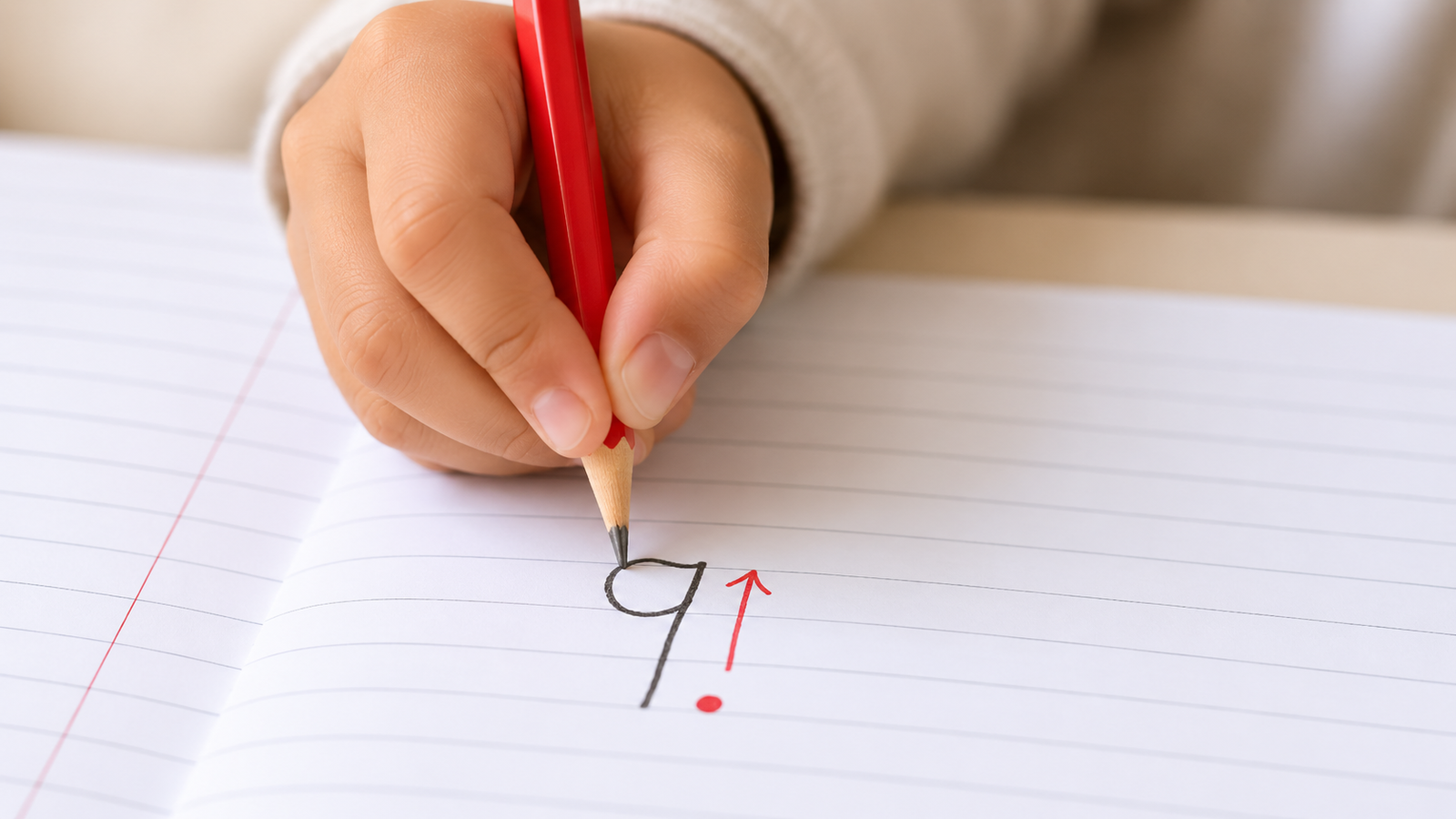
Sound familiar?
Homework tears. Rushed scribbles. “I hate writing.”
You’ve tried reminding, rewarding, and one more tuition centre. But if the grip is wrong and the letters were never anchored, your child is spending all their concentration on forming words instead of learning — in every subject, every day. That is exhausting at seven. It is devastating at thirteen. The seven signs, and what each really means →
The programme
Six weeks that change how school feels
Every class runs on the Move–Grip–Read and Write sequence — movement games first, grip check second, letterwork third. Here is the arc:
Weeks 1–2
Body & grip
Whole-body exercises and games build the motor control and left–right coordination writing depends on. The correct grip is set — and re-checked every class until it is the hand’s default.
Weeks 3–4
Letters, anchored
Every letter learned from its true starting point and direction — the permanent cure for b/d mirrors and shape-shifting a’s — with correct size, spacing and punctuation, in English and Bahasa Melayu together.
Weeks 5–6
Numbers, speed & proof
Number formation done right (so 5 never becomes S, and maths never becomes the enemy), building toward fluent, automatic writing — and a final before-and-after sample you can hold in your hands.
Two tracks, one method
Build it right — or repair it in time
Early Start track (ages 3–5). Before a single letter is formed. Whole-body movement builds the gross and fine motor control — and the left–right brain coordination — that writing actually rests on, then the correct grip and first strokes are introduced while nothing needs undoing.
Foundations track (ages 6–8). The golden window. Grip and letterforms are set correctly the first time, while the habit is still soft — so the cascade never begins.
Rescue track (ages 9–12). For the child already labelled messy, slow or careless. Habits are unlearned and re-anchored, with extra patience for the tantrums that come from a child who has learned to fear the page. Jameela has done this rescue for decades — one boy went from 2 marks in maths to public praise from his teacher in three weeks.
What’s included
Everything around the child
- 18 live classes (3 × 40 min weekly) — in person in KL or online
- Letter-path worksheets and notes for practice between classes
- Weekly parent updates — what changed, what to encourage at home
- Doubt-solving support on WhatsApp between classes
- Before & after writing sample — the change, visible on paper
- Applied to real schoolwork — BM, English, Maths and Science homework, not abstract drills
“At the start he showed his tantrums. Three weeks later his teacher praised his writing in front of the class — and now he studies on his own.”
Parent of a Rescue-track student, age 8 · shared with permission pending
Founding intake
Investment
Small group · 4–6 children
RM 480 /12 sessions
Six-week programme · 3 classes a week · all worksheets, notes, parent updates and WhatsApp doubt support included.
One-to-one
RM 150 /hour
Fully personal pace — often chosen for the Rescue track, or where scheduling needs flexibility. Same method, same materials, undivided attention.
Founding-intake pricing for the first Kuala Lumpur cohorts, reviewed each intake. A specialist foundation, set once, costs less than years of tuition that never reaches the root.
The honest guarantee
Start with the free handwriting check. If Teacher Jameela does not believe she can genuinely help your child, she will tell you so at the check — and point you toward who can. Fifty years in classrooms buys you a straight answer.
Seats are genuinely limited
Groups are capped at six because grip correction is hands-on — every child’s hand is checked, every class. When an intake fills, the next begins the following cycle.